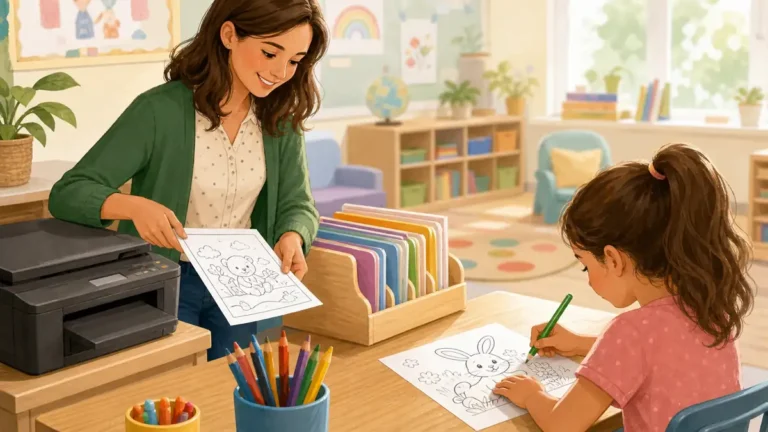



Coloring activities for early finishers solve one of the most persistent classroom management challenges — what meaningful, independent work do students who finish assigned tasks quickly do while their classmates complete their work? A well-designed early finisher coloring station is self-managing, curriculum-connected, genuinely engaging, and available without teacher intervention. When set up correctly, it’s one of the most effective differentiation tools a teacher can implement.
Why Coloring Works as an Early Finisher Activity
Early finisher activities have specific requirements that many options fail to meet: they must be immediately available without teacher setup, independently executable without instruction, variable in duration (so they can fill 5 minutes or 25), calm enough not to distract other students, and meaningful enough that students don’t resent being asked to do them. Coloring pages meet every requirement:
- Immediate availability: A pre-stocked early finisher folder or box requires zero teacher involvement to access
- Zero instruction needed: The activity is self-explanatory — select a page, color it
- Variable duration: A simple page takes 5 minutes; a detailed page with a writing extension can take 20+
- Noise profile: Silent — no collaboration, no materials to drop, no competing audio
- Visible product: A finished colored page is tangible evidence of productive use of time, satisfying for student and teacher alike
Setting Up an Early Finisher Coloring Station
The station setup determines whether the system runs itself or requires constant teacher management. A functional early finisher coloring station:
Physical Setup
- Container: A labeled box, accordion file, or tabletop folder holder — clearly marked “Early Finisher” so students know exactly where to go and what to do
- Page organization: Divide pages by type or difficulty — “Quick” (simple, 5–10 minutes) and “Challenge” (detailed, 15–25 minutes) — so students self-select appropriate duration
- Coloring tools: A shared pencil cup or small crayon box at the station — not requiring a trip to a pencil box that disturbs other students
- Extension prompt card: A laminated card with 3–4 extension choices students can add after coloring: “Label what you colored. Write 3 facts. Write a sentence. Draw what comes next.”
Page Selection Strategy
The most effective early finisher coloring pages are curriculum-connected. Pages that relate to the current unit feel purposeful; generic pages feel like filler, which students and teachers both notice. Rotate the available pages every 2–3 weeks to maintain novelty, and connect page themes to the current instructional content where possible.
By grade level:
- Kindergarten and Grade 1: Our alphabet pages, simple animal pages, and number pages are most appropriate — educational content at the right complexity level
- Grades 2–3: Our life cycle pages and science and nature pages provide curriculum-connected content at the right detail level
- Grades 4–5: More detailed science diagrams and complex nature illustrations appropriate for upper elementary fine motor capability
Making Early Finisher Coloring Educational
The extension prompt card is what separates an early finisher coloring station from a time-filler. When students complete their coloring and then choose an extension — labeling the diagram, writing three facts, writing a sentence about the subject, or drawing what comes next — the activity moves from passive creative work to active knowledge construction.
Without the extension option, coloring is reinforcement. With it, coloring becomes formative practice. The extension options should be open enough that students self-select the right challenge level rather than requiring teacher differentiation for each student.
Connecting Early Finisher Coloring to Sub Plans
An established early finisher coloring station doubles as a built-in sub plan resource — substitute teachers can direct early finishers to the station without any additional instruction or preparation. For a complete guide to no-prep sub plan coloring activities, see our article on no-prep coloring activities for sub plans.
For the full picture of how coloring pages function across all classroom contexts, see our pillar guide on classroom coloring pages for teachers.
Frequently Asked Questions
What are the best early finisher coloring activities for elementary students?
Curriculum-connected coloring pages — science diagrams, life cycle pages, alphabet pages, or seasonal nature pages tied to the current unit — are the most educationally justified early finisher activities. Pair them with an extension prompt (label, write facts, write a sentence) to add cognitive depth beyond the coloring itself. The best pages are detailed enough to take 10–20 minutes for careful students without overwhelming those who work quickly.
How do I prevent early finisher coloring from becoming just free time?
The extension prompt card is the key: students are expected to complete the coloring and then choose one extension activity. Display the expectation explicitly on the station card so students self-manage rather than requiring teacher reminders. When students know the coloring page comes with a thinking extension, they approach it as academic work rather than reward time.
How often should I change the early finisher coloring pages?
Rotate every 2–3 weeks. More frequent rotation is time-consuming; less frequent means motivated early finishers work through the available pages and have nothing new to engage with. A 2-week rotation with 8–10 pages at two difficulty levels gives most students sufficient variety within the rotation window.
A well-stocked early finisher coloring station is one of the most self-managing classroom management investments available. Set it up once, restock every two weeks, and it runs itself for the school year. Browse our science, life cycle, alphabet, and seasonal pages at cutecoloring.org to build your early finisher collection, and visit our Tips & Techniques hub for more classroom-ready resources.