

Teaching numbers with coloring pages combines the abstract task of number learning with the hands-on engagement of creative coloring — and the combination works better than either approach alone. A child who is asked to color three apples, identify the numeral 7 on a color-by-number page, or complete a pattern page is doing genuine math work in a format that doesn’t feel like a worksheet. This guide covers the specific ways math coloring pages can be used to build number recognition, counting, and early math concepts in preschool and kindergarten.
How Coloring Pages Teach Number Concepts
Numbers are abstract — a symbol that represents a quantity is a significant cognitive leap for a 3 or 4-year-old. Math coloring pages make that abstraction concrete through visual representation and kinesthetic engagement. Three mechanisms explain why coloring is effective for number learning:
- Visual representation: A large bold numeral 5 surrounded by five objects connects the symbol to the quantity in a way flashcards rarely achieve as durably
- Kinesthetic encoding: A child who traces the outline of a numeral while coloring is building motor memory of the number’s shape — the same motor memory that will guide handwriting later
- Reward encoding: Color-by-number pages create a direct reward for correct number identification — the revealed image is only possible if the numbers are correctly read and colored
Math Coloring Activities by Concept
Number Recognition (Ages 3–5)
Number recognition pages feature large, bold numerals — often with objects to count alongside them. The most effective use of these pages:
- Before coloring: say the number name and count the objects together (“This is the number 4. Let’s count the stars: 1, 2, 3, 4.”)
- During coloring: have the child trace the numeral outline with their finger before picking up the crayon
- After coloring: ask the child to find that number somewhere in the environment — on a clock, a calendar, a page number
This before-during-after sequence moves the number page from a passive coloring activity to an active number learning session. The coloring is the anchor; the instruction around it produces the learning.
Counting (Ages 3–6)
Counting pages embed one-to-one correspondence — the understanding that each number word corresponds to exactly one object — in a creative activity. Pages that ask children to color a specific number of objects (“Color 6 butterflies yellow. Color 3 flowers red.”) require genuine counting rather than guessing.
Extend counting pages with these prompts:
- “How many blue things are on your page now?”
- “If I colored 2 more flowers, how many would there be?”
- “Which has more — the butterflies or the flowers?”
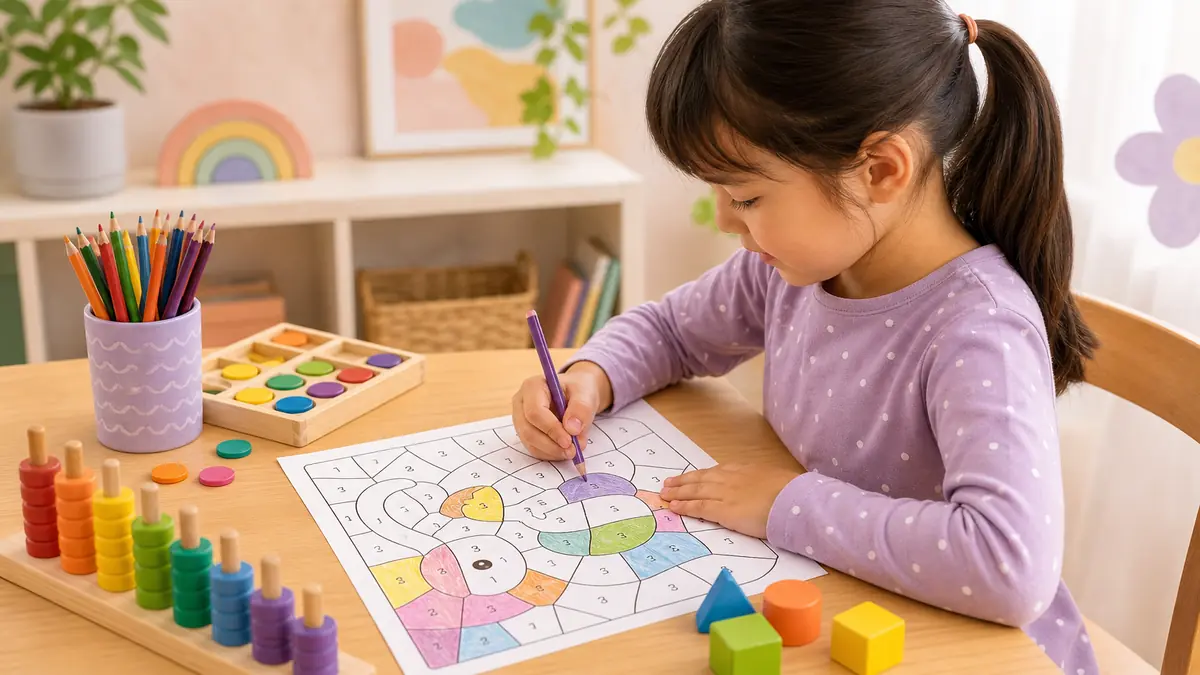
Color-by-Number (Ages 4–7)
Color-by-number pages are the most self-contained math coloring activity — the number identification challenge is built directly into the page design. A child who correctly identifies every numeral and colors accordingly reveals the intended image; errors produce a noticeably “wrong” result that provides immediate feedback.
Color-by-number pages are most effective when the child can recognize all the numerals used — a page using numbers 1–5 for a preschooler who knows 1–10 is appropriate; a page using numbers 1–20 for a child who only recognizes 1–5 produces frustration rather than math practice.
Patterns (Ages 4–7)
Pattern pages make repeating sequences visual and colorable. Completing an ABAB or ABCABC pattern requires the child to identify the rule governing the sequence and extend it — a foundational algebraic thinking skill. The visual, colorable format makes this abstract concept accessible years before formal algebra instruction.
Geometry (Ages 4–8)
Shape identification pages — featuring named geometric shapes in compositions children color and label — build the shape vocabulary that formal geometry instruction builds on. A child who has colored, named, and labeled circles, squares, triangles, and rectangles dozens of times before kindergarten arrives at formal shape instruction with solid prior knowledge.
Integrating Math Coloring Pages into Your Routine
Math coloring pages deliver the most value when used consistently alongside other number instruction rather than as a standalone activity. Best integration points:
- Before a math lesson: A number recognition or counting page introduces the concept visually before formal instruction begins
- After a math lesson: A color-by-number or pattern page consolidates the concept just taught through a different modality
- Morning work: A simple number or counting page as daily morning warm-up for kindergarten and first grade
- Practice reinforcement: When a specific number concept (teen numbers, skip counting, pattern recognition) needs extra practice, a themed coloring page provides an engaging repetition that worksheets rarely match
Browse our full math coloring pages library for number, counting, pattern, and geometry pages across the preschool through early elementary range. For how to teach letters with the same approach, see our guide to how to teach letters with coloring pages.
Frequently Asked Questions
What age should kids start math coloring pages?
Number recognition and simple counting pages are appropriate from age 3. Color-by-number pages require numeral recognition and are most effective from age 4–5 when most children have basic numeral knowledge. Pattern pages are appropriate from age 4 when pattern recognition is developmentally emerging. Match the page to the specific concepts the child is currently learning rather than strictly to age.
Do color-by-number pages actually teach math?
Yes — correctly executed color-by-number pages require genuine number identification. A child who successfully completes a color-by-number page using numerals 1–10 has demonstrated that they can correctly identify each of those numerals independently and apply them to produce a specific outcome. This is authentic number recognition practice embedded in a motivating creative activity rather than drill for its own sake.
How are math coloring pages different from math worksheets?
Math worksheets require written answers in a format many young children find frustrating before their fine motor skills support confident pencil use. Math coloring pages require the same cognitive work (number identification, counting, pattern recognition) but deliver the response through coloring — a more accessible motor activity for most preschool and early kindergarten children. The engagement level is also significantly higher: children who refuse worksheets often engage willingly with the same math content on a coloring page.
Math coloring pages work best as part of an intentional math teaching approach rather than as isolated activities. Browse our math pages at cutecoloring.org and visit our Tips & Techniques hub for structured approaches to math coloring across grade levels.