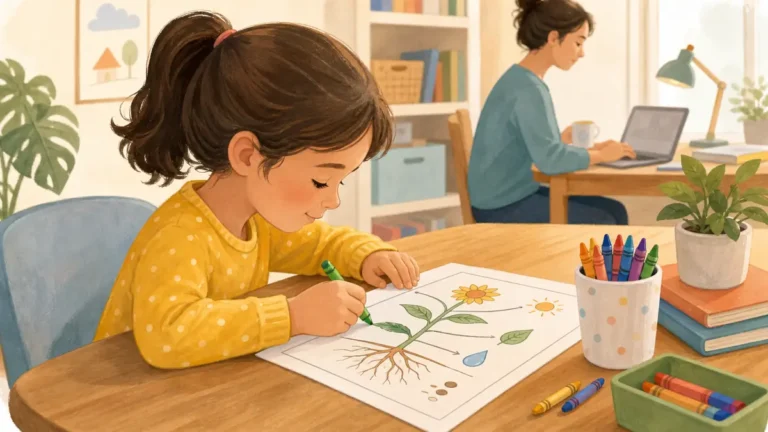

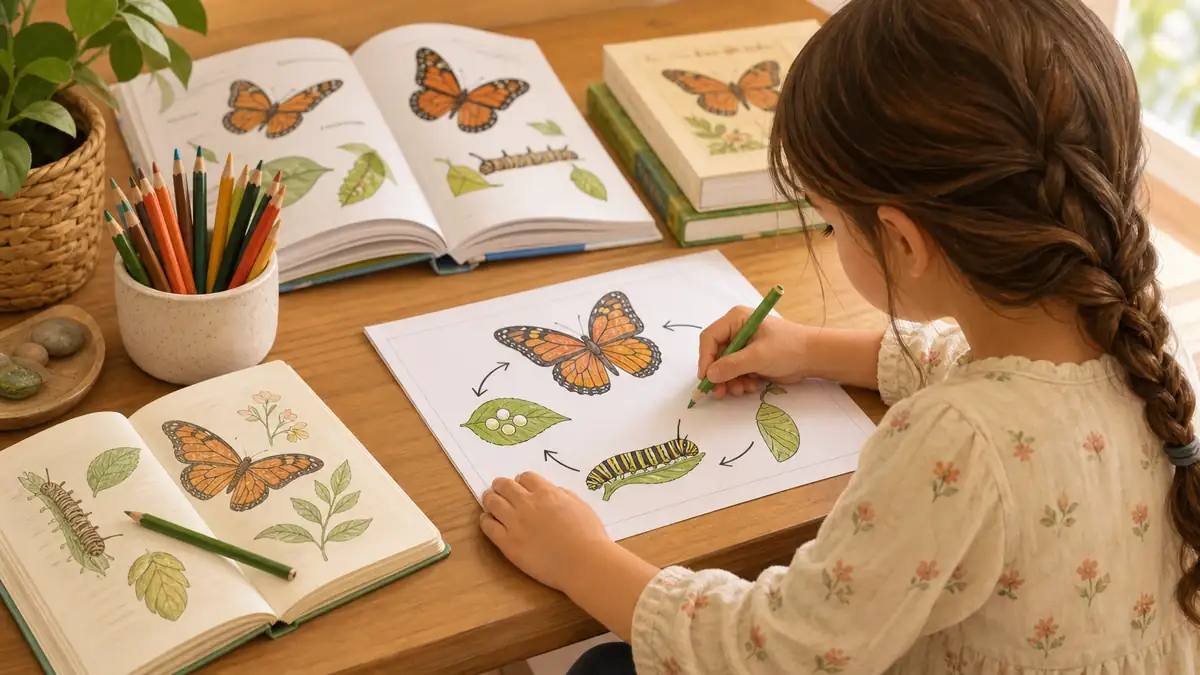

Homeschool unit studies with coloring pages work because coloring pages do something unit studies inherently need: they create a visual, tangible representation of the unit’s central concepts that children can touch, complete, and keep as a reference artifact. A butterfly unit is richer when each stage of the life cycle is something the child has colored, labeled, and held in their hands. A geography unit is more memorable when the child has colored the map region under study. This guide covers how to integrate coloring pages into the major unit study types and build illustrated unit notebooks that become lasting learning records.
How Coloring Pages Function in Unit Studies
In a well-designed unit study, coloring pages serve three distinct roles at different points in the unit’s arc:
- Visual pre-loader (unit opener): Coloring the central diagram before reading begins creates spatial pre-knowledge — the child has a visual framework into which subsequent reading slots. A butterfly life cycle page colored on day one of a butterfly unit makes the unit’s reading significantly more comprehensible because the child already has a mental spatial model of the content.
- Knowledge consolidator (mid-unit): A coloring and labeling session mid-unit checks and consolidates current understanding. What can the child label from memory? Where do they need to refer back to their reading? The labeling activity is a formative assessment without test anxiety.
- Unit notebook page (unit closer): The finished, labeled coloring page becomes a page in the child’s illustrated unit notebook — a tangible record of the unit’s visual content that the child can return to when reviewing or building on prior knowledge in a later unit.
Unit Study Coloring by Topic
Life Science Units
Life science unit studies — insects, birds, mammals, plants, ocean life, habitats — are the most naturally coloring-page-rich unit type because biological content is so inherently visual. Life cycle pages are the cornerstone:
- Insect units: Butterfly and other insect life cycle pages — our life cycle pages cover the most-studied insect species
- Amphibian units: Frog and tadpole life cycle pages connecting aquatic to terrestrial life stages
- Plant units: Plant anatomy and plant life cycle pages — our flowers and plants pages provide the visual vocabulary for botany units
- Animal habitat units: Our animal pages and science and nature pages cover the major habitat types and their characteristic species
Earth Science Units
Earth science unit studies — weather, seasons, geology, the solar system, water cycle — benefit from diagram coloring that makes abstract processes visible. A child who colors a water cycle diagram with each stage in a different color has a visual-spatial understanding of the process that reading alone rarely produces. Our science and nature pages include Earth science content appropriate for elementary units.
Seasonal Nature Units
Seasonal unit studies — organized around the observable changes of each season — are among the most Charlotte Mason-aligned unit types, and coloring pages connect them to the natural world in concrete, tangible ways. Our seasonal coloring pages are organized by month for easy seasonal unit integration.
Building an Illustrated Unit Notebook
An illustrated unit notebook — assembled from completed, labeled coloring pages plus the child’s written narrations and sketches — is one of the most meaningful products a unit study can produce. Unlike a worksheet packet that gets filed and forgotten, an illustrated notebook that a child has assembled, colored, and written in is a record they often keep for years and return to with genuine interest.
Construction:
- Use a simple composition notebook or a 3-ring binder with plain paper
- For each unit, include: 2–3 coloring pages (labeled and completed), 2–3 narration pages (child’s written or dictated summaries), sketches from nature observation, and a “what I learned” closing page
- Allow the child to arrange the pages in a sequence that makes sense to them — the organizational decision is itself a learning activity
- Date and title each notebook — over a year, the accumulation of illustrated units becomes a visual portfolio of the year’s learning
Sample Unit Study Coloring Integration
Butterfly Unit (2 weeks, ages 5–9):
- Day 1: Color butterfly life cycle page — label stages with parent help or independently
- Day 3: Color caterpillar page after outdoor observation or book reading about caterpillar behavior
- Day 7: Color adult butterfly page — discuss wing patterns, habitat, and migration
- Day 10: Assemble butterfly unit notebook page — life cycle + narration + sketches
For a full homeschool coloring framework beyond unit studies, see our pillar guide on homeschool coloring pages and printables. For science-specific coloring approaches, see our guide to science coloring pages for kids.
Frequently Asked Questions
What unit study topics work best with coloring pages?
Life science units — insects, animals, plants, habitats, and life cycles — produce the greatest educational value from coloring pages because biological content is so diagram-dependent. Earth science (weather, water cycle, seasons) and geography (maps, habitats, regional study) are the next most effective. History and social studies units benefit from people and cultural pages that make abstract historical content more concrete.
How many coloring pages should a unit study include?
Two to four coloring pages per unit is optimal — enough for visual variety and multiple encoding passes without overwhelming the study with coloring at the expense of reading and narration. Each page should serve a specific role: one as unit opener, one as mid-unit consolidation, one as unit notebook page. Additional pages can serve as morning basket enrichment during the unit’s duration.
Can coloring pages be the spine of a unit study for very young children?
For children ages 3–5 who are not yet ready for sustained reading or narration, coloring pages can serve as the primary content vehicle for simple nature units. A preschool butterfly unit organized around three coloring sessions — caterpillar, chrysalis, butterfly — paired with picture book read-alouds and outdoor observation is a complete and appropriate unit for this age. The coloring is the academic anchor; the read-aloud and observation are the enrichment.
Homeschool unit studies with coloring pages produce the illustrated, tangible learning records that children and families treasure long after the unit is complete. Browse our life cycle, science and nature, flowers and plants, and animal pages at cutecoloring.org to build your unit study coloring library, and visit our Tips & Techniques hub for topic-specific unit study guides.